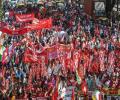
'Major unions should be included. If this goes on, decision-making will become heavily one-sided and we will be forced to continue our strikes.'

A nationwide strike called by central trade unions saw a mixed response across India, impacting various sectors and states differently, with some areas experiencing disruptions while others remained largely unaffected.
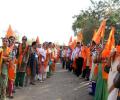
BMS allies with breakaway faction of Congress-affiliated INTUC. This marks a new chapter in India's trade union movement

Ten central trade unions on Tuesday said they are going ahead with their planned nationwide general strike on November 26 and also announced their support to a two-day farmers' agitation next week. The meeting of the Joint Platform of Central Trade Unions (CTUs) and Sectoral Independent Federations and Associations was held virtually on November 16, 2020. Unions expressed satisfaction over the tremendous response being received from workers and the people at large throughout the country to the ongoing campaign for the countrywide general strike on November 26, 2020, a joint forum statement said.

All India Trade Union Congress General Secretary Gurudas Dasgupta said the Common Minimun Programme was 'inadequate' and not 'acceptable'.
Finding that the draft common minimum programme was "inadequate", the central trade unions on Monday said it was not "acceptable" to them and laid out over a dozen demands to the new government headed by Prime Minster Manmohan Singh.
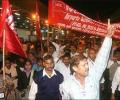
The trade unions would jointly carry out demonstrations, sit-ins and other forms of protests on October 28 to focus on the government's economic policies which were leading to job losses and hiking the prices of essential commodities.

Talking to PTI Amarjeet Kaur, General Secretary of All India Trade Union Congress (AITUC), said, "The two-day nationwide strike by the joint forum of central trade unions has begun this morning". About the impact of the agitation, she said that the entire coal belt (mining area) is affected in Jharkhand, Chhattisgarh and Madhya Pradesh. She also said that there is a good response in industrial areas of Assam, Haryana, Delhi, West Bengal, Telangana, Kerala, Tamil Nadu, Karnataka, Bihar, Punjab, Rajasthan, Goa, Andhra Pradesh and Odisha. The AITUC official noted that the banks and insurance sectors are affected all over India, while steel and oil sectors are also seeing partial impact due to the strike. Kaur said that she has got preliminary reports that markets are closed in Odisha.

The Congress party has strongly criticised the Modi government's decision to introduce a 0.4% Merchant Discount Rate (MDR) on UPI transactions over Rs 2,000, alleging it is a result of US pressure to benefit American card companies. The party also linked this move to broader US actions against India, including tariffs and H-1B visa issues, coining the term "Narendra's Ongoing Trump Appeasement." The government, however, clarified that consumers will not bear the charge, which applies only to merchants.

External Affairs Minister S Jaishankar will host US Secretary of State Marco Rubio in Mumbai on October 20 for talks aimed at strengthening the Comprehensive Global Strategic Partnership. Discussions will cover energy, trade, defence, and critical technologies. The visit also includes celebrations for the 250th anniversary of US Independence. This meeting follows earlier confusion regarding Rubio's visit and will also touch upon the India-US bilateral trade agreement, which both sides are close to concluding. The MEA clarified that hosting foreign dignitaries outside Delhi is a common practice.

BMS general secretary Virjesh Upadhyay said, "There are many anomalies in the draft rules on Code on Wages which need to be amended. The new rules are silent about many provisions clearly provided in the four Acts subsumed in the code."

Several prominent INDIA bloc leaders, including Arvind Kejriwal and Mamata Banerjee, were detained by Delhi Police on Saturday while attempting to protest at Jantar Mantar. They were demanding the resignation of Chief Election Commissioner Gyanesh Kumar over alleged irregularities in electoral rolls, with leaders condemning the detentions as an attack on democracy.
The unions would give the notice for strike to the Government on August 4, All India Trade Union Congress' Andhra Pradesh unit General Secretary P J Chandrasekhar Rao told reporters in Vijayawada on Wednesday. Prior to that, the union representatives would meet here on July 21 to finalise their stragegy for the stir, he said. The strike call has been given by 56 unions and their affiliated units which have prepared a seven-point charter of demands, Rao said.
The Congress party has accused the Indian government of imposing new charges on UPI transactions due to pressure from the United States, specifically to benefit American card companies. The opposition party demanded the withdrawal of the decision, calling it "anti-national" and alleging it fills the coffers of US firms while burdening Indian citizens. The government, however, clarified that the Merchant Discount Rate (MDR) charges apply only to commercial transactions above Rs 2,000 and are not levied on consumers, a stance supported by the BJP which accused Congress of spreading "fake news".

The two-day nationwide strike called by central trade unions to protest the Centre's alleged anti-worker policies evoked mixed response all over country on Tuesday.

Amid the ongoing protests in the national capital, the Bharatiya Udyog Vyapar Mandal (BUVM), Delhi Pradesh, has written to Prime Minister Narendra Modi, Leader of the Opposition Rahul Gandhi and Aam Aadmi Party national convenor Arvind Kejriwal, appealing for political demonstrations in the capital to be postponed until January 31, 2027, citing the festival and wedding season.
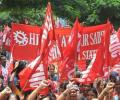
Trade unions said Jaitley's minimum wage announcement is completely inadequate

Opposition parties, including Congress, TMC, and RJD, have strongly criticised the government's decision to impose a 0.4% Merchant Discount Rate (MDR) on UPI transactions exceeding Rs 2,000 made to merchants. They allege the move is a result of "American imperialism" and will lead to increased commodity prices, while the government maintains the charge is on merchants and not consumers, with person-to-person transactions remaining free.
The Congress party has accused the Modi government of succumbing to US pressure by introducing a 0.4% Merchant Discount Rate (MDR) on UPI transactions over Rs 2,000 for merchants. The party alleges this move aims to benefit US card companies and links it to broader US actions against India, including tariffs and H-1B visa issues. The government, however, clarifies that consumers will not be charged.

The opposition has strongly criticised the government's decision to introduce a 0.4% Merchant Discount Rate (MDR) on UPI transactions above Rs 2,000 for merchants, effective October 15. They allege the move is a result of US pressure and will lead to increased commodity prices, calling it a "betrayal" of the common man. The government, however, clarifies that customers will not be charged, and the MDR applies only to merchants for larger transactions.
The opposition has intensified its criticism of the government's decision to impose a 0.4 per cent Merchant Discount Rate (MDR) on UPI transactions above Rs 2,000, effective October 15. Leaders like Rahul Gandhi and Jairam Ramesh allege the move is a result of US pressure, particularly from American card companies, and demand an immediate rollback, warning of increased costs for consumers.

The Congress attacked the Modi government, saying it now seems to be routine that India learns about its government's actions only from Trump or his appointees.

Employees and workers will meet on November 27 to protest against the recommendations

'Tariff action relating to the excess-capacity investigation will be even more susceptible to judicial overturn.'

The Congress escalated its campaign against alleged examination irregularities by marching to Prime Minister Narendra Modi's residence, transforming the issue into a direct challenge to his political authority and demanding the resignations of top government officials.

A proposed Rs 1,200 crore Secretariat-Assembly complex in Pattinapakkam, Chennai, has ignited significant opposition from local fishing communities and various political parties. Residents fear displacement, loss of livelihood, and environmental damage, citing ancestral rights and broken promises. Political leaders across the spectrum are urging Chief Minister C Joseph Vijay to reconsider the site, highlighting concerns about ecological impact, traffic, and financial priorities.
The Congress party is set to challenge the Modi government on a range of critical issues, including alleged theft of Ram temple donations, 'systemic corrosion' of the education system, and constitutional amendment bills related to delimitation and dismissal of ministers, during the upcoming Monsoon Session of Parliament.

'Workers are the people who create all the wealth in this country. How can you call them anti-national?'

'You have to get private investment to somewhere between 35% to 36% of GDP. It is hovering about 30%-31%.'

'Wages have not risen. Rural wages have stagnated. The growth was 0.7 per cent last year. For casual and irregular labour, the wage growth is negative.'

Rising living expenses, fear of contract hiring cast shadow on real gains.

Three All India Anna Dravida Munnetra Kazhagam legislators who were part of the rebel group led by C Ve Shanmugam and SP Velumani, met Tamil Nadu assembly Speaker JC D Prabhakar on Monday and tendered their resignation.

The deal shifts the US posture towards India from hostile to neutral, and that matters for growth, points out T T Ram Mohan.

The BJP and the Opposition have engaged in a war of words over the implementation of the women's reservation bill, which aims to reserve seats for women in legislatures. The bill was defeated in the Lower House, leading to accusations and counter-accusations between the parties.

'Workers are being pushed into 12- to 14-hour shifts under poor conditions. These largely leaderless protests are likely to continue.'

The dramatic development marked the culmination of a revolt that began with allegations of forged signatures on a letter proposing a Leader of Opposition and snowballed into an open challenge to the party leadership following the TMC's defeat at the hands of the BJP in the assembly elections.

'The Dravidian parties wanted to prevent the TVK from forming a government.'

More than 25 crore workers engaged in sectors ranging from banking, insurance, postal to coal mining, highway and construction are expected to go on a nationwide general strike on Wednesday, potentially disrupting services across the country. A forum of 10 central trade unions and their associates has called for a general strike or 'Bharat Bandh' to "oppose the anti-worker, anti-farmer and anti-national pro-corporate policies of the government".
Air services may be disrupted on August 20 as airport employees have decided to join the major trade unions in their general strike against the "anti-people" policies of the United Progressive Alliance (UPA) government.

'The BJP and its allies can decide the fate of many candidates.'
